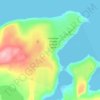
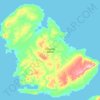
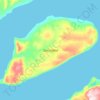
Mount Odin topographic map
Click on the map to display elevation.
Mount Odin
Mount Odin is the highest mountain within the Baffin Mountains as well as the fifth-highest in the Arctic Cordillera. It has a topographic prominence of 2,147 m (7,044 ft), greater than any other mountain within the Baffin Mountains and on Baffin Island, making Odin the third-highest mountain in Nunavut by topographic prominence. Comparing absolute peaks, Mount Odin is the fifth-highest in Nunavut. The higher points in Nunavut are: Barbeau Peak on Ellesmere Island (the highest point in Nunavut at 2,616 m), two unnamed peaks on Ellesmere Island, (one at 2,347 m located at 78° 48' N, 79° 34' W and one at 2,201 m located at 80° 17' N, 75° 05' W) and Outlook Peak on Axel Heiberg Island, which at 2210 m is just 63 m higher than Mount Odin.
About this map
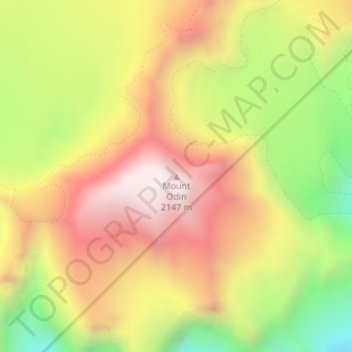
Name: Mount Odin topographic map, elevation, terrain.
Location: Mount Odin, Qikiqtaaluk Region, Nunavut, Canada (66.54691 -65.42656 66.54701 -65.42646)
Average elevation: 1,440 m
Minimum elevation: 735 m
Maximum elevation: 2,131 m
Qikiqtaaluk Region trails, hiking, mountain biking, running and outdoor activities
Other topographic maps
Click on a map to view its topography, its elevation and its terrain.

Arctic Bay
Canada > Nunavut > Qikiqtaaluk Region
Arctic Bay experiences a tundra climate (Köppen: ET) like most northern Canadian territories at low elevations, with long, very cold winters and short, cool to cold summers. July is the only month with an average low temperature above freezing. Its climate does not differ from the more severe subarctic…
Average elevation: 160 m
Arctic Bay
Canada > Nunavut > Qikiqtaaluk Region
Arctic Bay experiences a tundra climate (Köppen: ET) like most northern Canadian territories at low elevations, with long, very cold winters and short, cool to cold summers. July is the only month with an average low temperature above freezing. Its climate does not differ from the more severe subarctic…
Average elevation: 137 m


Arctic Bay
Canada > Nunavut > Qikiqtaaluk Region
Arctic Bay experiences a tundra climate (Köppen: ET) like most northern Canadian territories at low elevations, with long, very cold winters and short, cool to cold summers. July is the only month with an average low temperature above freezing. Its climate does not differ from the more severe subarctic…
Average elevation: 137 m