

Columbia Icefield topographic map
Click on the map to display elevation.
Columbia Icefield
The Columbia Icefield sits on a large area of relatively horizontal layers of rock. Because flat-lying layers erode more slowly than the surrounding tilted areas, the surface remains higher-altitude and therefore colder. The icefield was formed during the Great Glaciation, or Illinoian period (238,000 to 126,000 BCE). The initial advancement of the ice field ended during the latter millennia of the Early Wisconsinan period (73,000 to 62,000 BCE). The next major advance of the ice field occurred during the Late Wisconsinan period (18,000 to 9,000 BCE), which marked the end of the major intercontinental land mass bridges. During the Crowfoot Glacier advance (9,000 to 7,000 BCE), humans were beginning to learn farming along the Tigris, Euphrates, and Nile rivers. The last major period of advance occurred during the Little Ice Age, which lasted from about 1200 AD to 1900 AD. Around 1800, the Athabasca Glacier peaked, then went through a period of recession, and then advanced again until 1840, when it began receding until the present day.
About this map
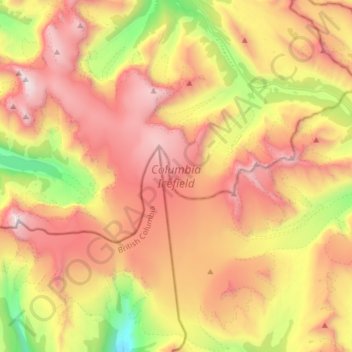
Name: Columbia Icefield topographic map, elevation, terrain.
Average elevation: 2,497 m
Minimum elevation: 1,229 m
Maximum elevation: 3,751 m
Improvement District No. 9 trails, hiking, mountain biking, running and outdoor activities